Lewis NDAMBIRI | Industrial Engineer & AI/Data Science Specialist
Dual Master's in Industrial Engineering & Computer Science | Optimization, Data, Automation
🚀 Parallel Romberg Integration: HPC Implementation




High-performance parallel implementation of Romberg numerical integration using MPI and hybrid MPI+OpenMP strategies
Developed as part of the High Performance Computing for Data Science (HPC4DS) course at the University of Trento (2025-2026).
Authors: Lewis Ndambiri & Mehrab Fajar
📋 Table of Contents
- Overview
- Key Features
- Performance Highlights
- Algorithm Background
- Implementation Strategies
- Project Structure
- Getting Started
- Running Experiments
- Results Visualization
- Performance Analysis
- Technical Details
- Future Work
- Acknowledgments
- License
🎯 Overview
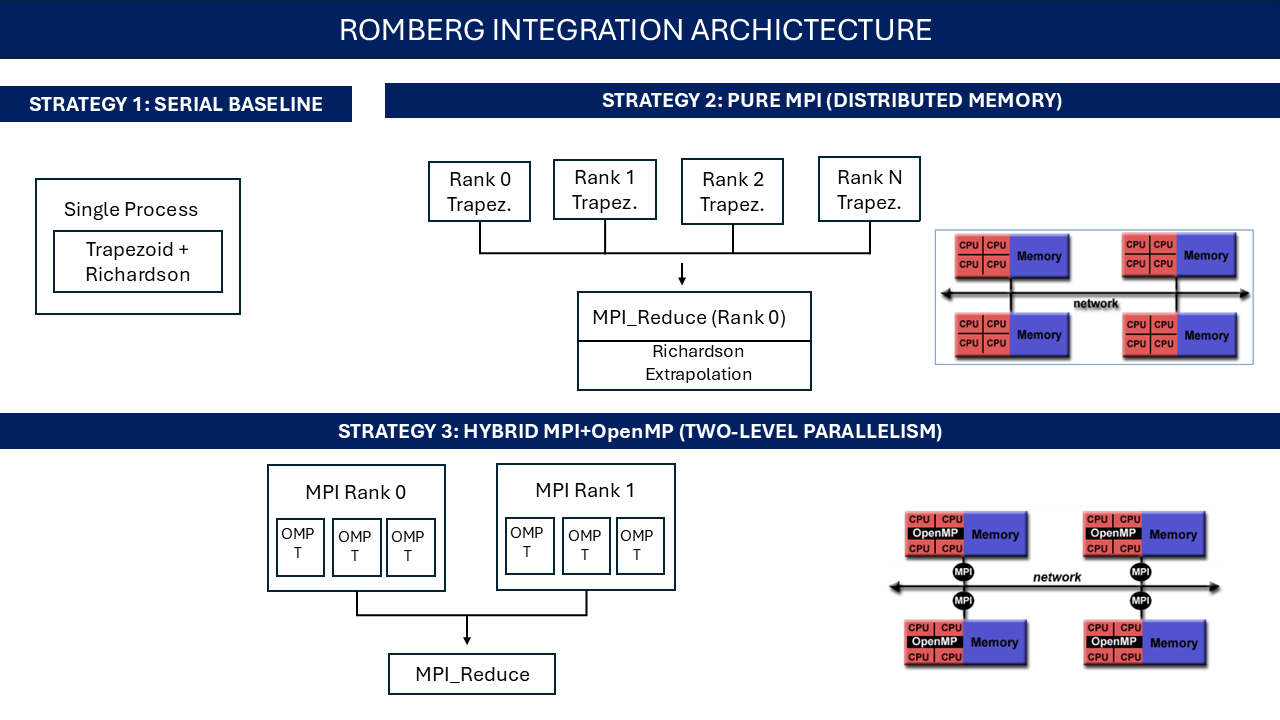
This project implements parallel Romberg integration, a sophisticated numerical method combining the trapezoidal rule with Richardson extrapolation. We developed three implementations:
- Serial baseline – Pure sequential implementation for benchmarking
- Pure MPI – Distributed memory parallelization using message passing
- Hybrid MPI+OpenMP – Two-level parallelism exploiting distributed + shared memory
The implementations were tested on the University of Trento HPC cluster (6,092 CPU cores, Infiniband/Omnipath interconnect) with comprehensive scalability analysis.
✨ Key Features
- Production-grade implementation with proper error handling and timing
- Multiple parallelization strategies (MPI, Hybrid MPI+OpenMP)
- Heavy computational workload simulation (10⁶ iterations per function evaluation)
- Automated benchmarking suite with PBS job submission scripts
- Comprehensive scalability analysis (strong, weak, placement strategies)
- Visualization tools for performance metrics and speedup curves
- Clean, documented codebase following HPC best practices
🏆 Performance Highlights
Strong Scaling (Fixed Problem Size)
| Configuration | Speedup | Efficiency | Problem Size |
|---|---|---|---|
| 32 cores | 31.77× | 99.3% | Level 16 (65K intervals) |
| 32 cores | 21.70× | 67.8% | Level 20 (1M intervals) |
| 16 cores | 18.12× | 113.2% | Level 16 (super-linear!) |
Key Findings
- 🎯 Near-perfect linear scaling up to 32 cores for medium-sized problems
- 🚀 Super-linear speedup observed due to improved cache utilization
- ⚠️ Communication overhead dominates beyond 64 cores for large problems
- 📊 Hybrid MPI+OpenMP underperformed pure MPI for this algorithm class
📚 Algorithm Background
What is Romberg Integration?
Romberg integration is an extrapolation method that:
- Computes successive trapezoidal approximations with increasing refinement
- Applies Richardson extrapolation to eliminate low-order error terms
- Achieves higher-order accuracy with fewer function evaluations than basic methods
Mathematical formulation:
R[i][0] = Trapezoidal rule with n = 2^i intervals
R[i][j] = R[i][j-1] + (R[i][j-1] - R[i-1][j-1]) / (4^j - 1)
Test Problem
We integrate:
f(x) = sin(x) * exp(-x²) over [0, π]
To simulate expensive HPC workloads (PDE solvers, physics simulations), each function evaluation is repeated 1 million times.
🔧 Implementation Strategies
1️⃣ Pure MPI (Distributed Memory)
Parallelization approach:
- Domain decomposition: Distribute trapezoidal subintervals across processes
- Load balancing: Block partitioning with remainder distribution
- Communication: Single
MPI_Reduceper Romberg level - Extrapolation: Sequential on rank 0 (negligible overhead)
// Block partitioning with balanced remainder distribution
int base = n / comm_sz;
int remainder = n % comm_sz;
int local_n = base + (my_rank < remainder);
Why MPI_Reduce instead of MPI_Allreduce?
- Only rank 0 needs the global sum for Romberg table construction
- Eliminates unnecessary communication overhead
- Other processes remain idle during extrapolation (acceptable given fast sequential computation)
2️⃣ Hybrid MPI+OpenMP
Two-level parallelism:
- MPI: Distributes subintervals across nodes (coarse-grained parallelism)
- OpenMP: Parallelizes local function evaluations within nodes (fine-grained parallelism)
#pragma omp parallel for reduction(+: local_sum) schedule(static)
for (int i = 1; i < local_n; i++) {
    local_sum += f(local_a + i * h);
}
Hybrid configuration tested:
- MPI ranks: {2, 4, 8}
- OpenMP threads per rank: 2
- Total cores: {4, 8, 16}
Finding: Pure MPI outperformed hybrid for this algorithm due to thread management overhead and NUMA effects.
🔧 Project Archictecture
📁 Project Structure
romberg-hpc4ds/
├── src/
│   ├── romberg_serial.c          # Serial baseline
│   ├── romberg_mpi.c              # Pure MPI implementation
│   └── romberg_mpi_openmp.c       # Hybrid MPI+OpenMP version
│
├── scripts/
│   ├── romberg_serial.pbs         # PBS job template (serial)
│   ├── romberg_mpi.pbs            # PBS job template (MPI)
│   ├── romberg_hybrid.pbs         # PBS job template (hybrid)
│   └── run_experiments.sh         # Automated benchmarking suite
│
├── analysis/
│   └── analyze_romberg_logs.py    # Performance visualization tools
│
├── results/
│   ├── *.out                      # Job output files
│   ├── *.csv                      # Performance data
│   └── *.png                      # Generated plots
│
├── Makefile                       # Build automation
├── README.md                      # This file
└── LICENSE                        # MIT License
🚀 Getting Started
Prerequisites
- C compiler with MPI support (
mpicc) - MPI implementation (MPICH, OpenMPI)
- OpenMP support (for hybrid version)
- Python 3.x with matplotlib, numpy, scipy (for analysis)
- PBS/Torque job scheduler (for cluster execution)
Installation
- Clone the repository:
git clone https://github.com/lewisndambiri.io/romberg-hpc4ds.git cd romberg-hpc4ds - Build all versions:
make clean
make all
This compiles:
romberg_serial– Serial baselineromberg_mpi– Pure MPI versionromberg_mpi_openmp– Hybrid version
- Verify compilation:
./romberg_serial 10      # Run serial with 10 Romberg levels
mpiexec -n 4 ./romberg_mpi 10  # Run MPI with 4 processes
🧪 Running Experiments
Local Testing (Single Machine)
Serial execution:
./romberg_serial 16
MPI parallel execution:
mpiexec -n 4 ./romberg_mpi 16
Hybrid execution:
export OMP_NUM_THREADS=2
mpiexec -n 4 ./romberg_mpi_openmp 16
Cluster Deployment (PBS)
Submit individual jobs:
qsub scripts/romberg_serial.pbs
qsub scripts/romberg_mpi.pbs
qsub scripts/romberg_hybrid.pbs
Run complete benchmark suite:
./scripts/run_experiments.sh
This automated script submits jobs for:
- Serial baselines (L16, L20)
- Strong scaling (p ∈ {2, 4, 8, 16, 32, 64})
- Weak scaling (work per processor constant)
- Placement strategies (pack, scatter, excl)
- Hybrid MPI+OpenMP configurations
Monitor job status:
qstat -u $USER
📊 Results Visualization
Generate Performance Plots
After jobs complete, run the analysis script:
cd analysis/
python3 analyze_romberg_logs.py
This generates:
- Strong scaling speedup (L16 vs L20)
- Strong scaling efficiency (L16 vs L20)
- Weak scaling efficiency
- Hybrid scaling speedup & efficiency
- Placement strategy comparison
- Amdahl’s Law fit
Plots are saved to results/*.png with CSV data exported for further analysis.
📈 Performance Analysis
Strong Scaling Results
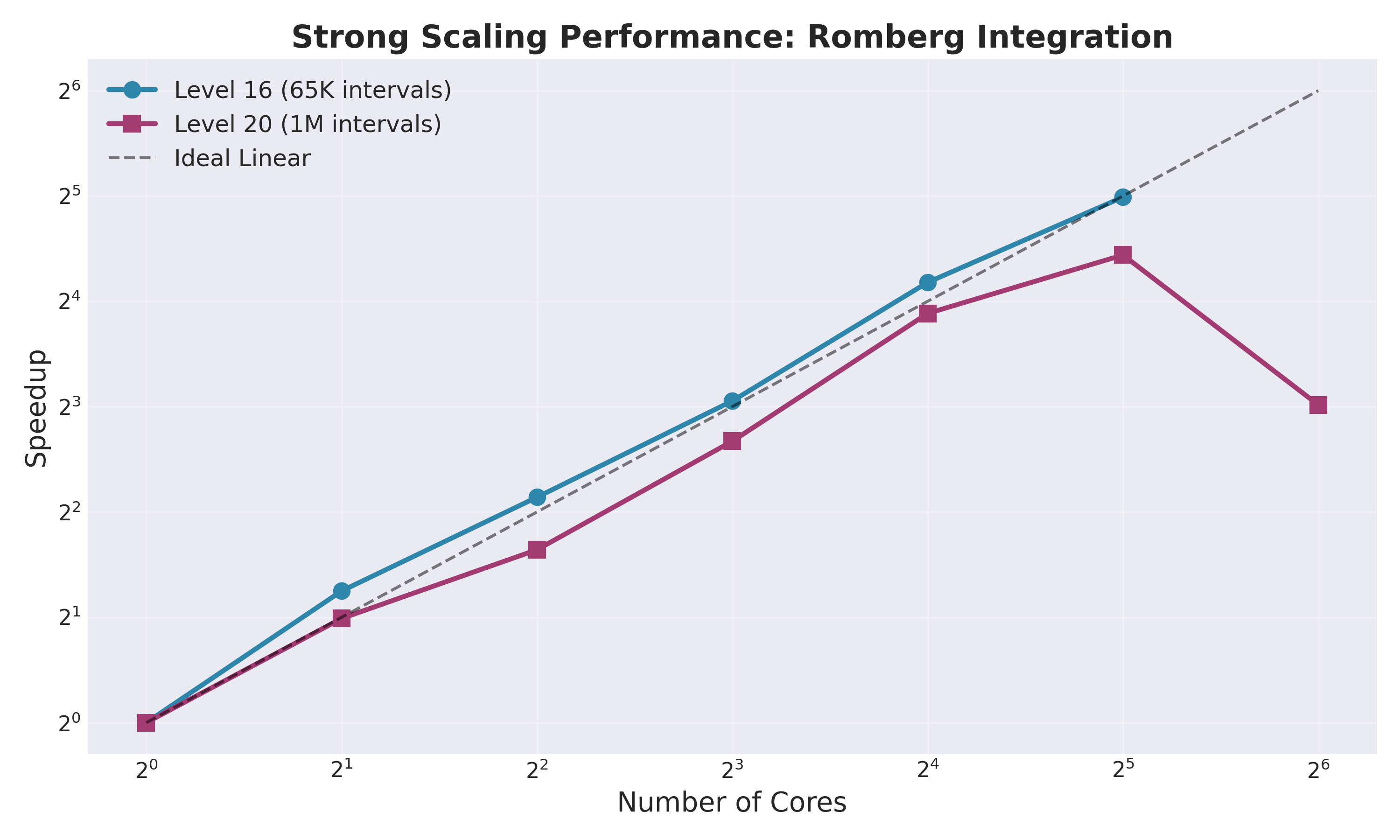
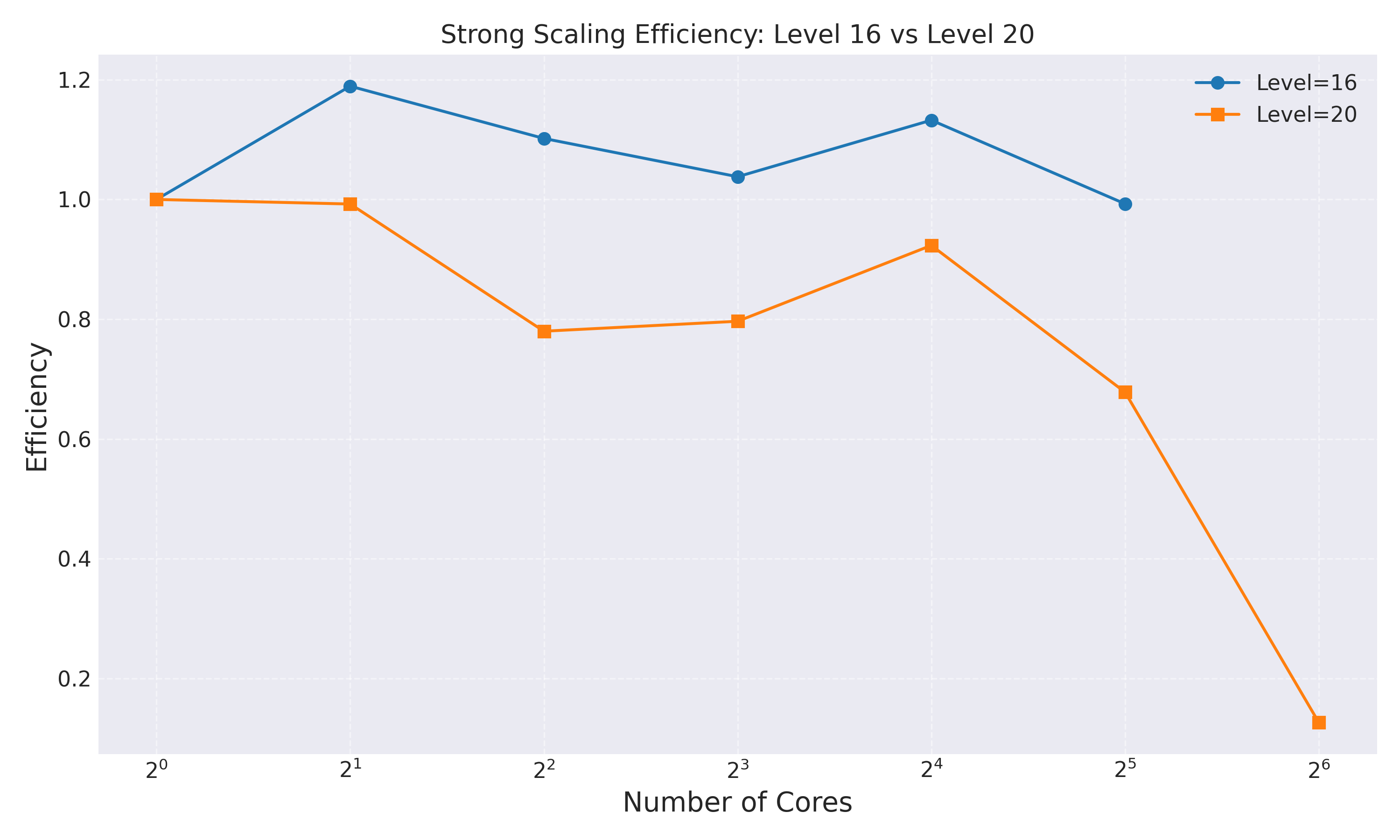
Level 16 (65,536 intervals)
| Cores | Time (s) | Speedup | Efficiency |
|---|---|---|---|
| 1 | 176.17 | 1.00 | 100.0% |
| 2 | 74.07 | 2.38 | 118.9% |
| 4 | 39.97 | 4.41 | 110.2% |
| 8 | 21.22 | 8.30 | 103.8% |
| 16 | 9.72 | 18.12 | 113.2% |
| 32 | 5.55 | 31.77 | 99.3% |
Analysis: Super-linear speedup up to 16 cores due to improved cache locality. Near-perfect efficiency at 32 cores.
Level 20 (1,048,576 intervals)
| Cores | Time (s) | Speedup | Efficiency |
|---|---|---|---|
| 1 | 2482.75 | 1.00 | 100.0% |
| 2 | 1250.90 | 1.98 | 99.2% |
| 4 | 795.84 | 3.12 | 78.0% |
| 8 | 389.62 | 6.37 | 79.7% |
| 16 | 168.07 | 14.77 | 92.3% |
| 32 | 114.42 | 21.70 | 67.8% |
| 64 | 306.86 | 8.09 | 12.6% |
Analysis: Efficiency degrades at 64 cores due to communication overhead exceeding computation benefits.
Weak Scaling Results
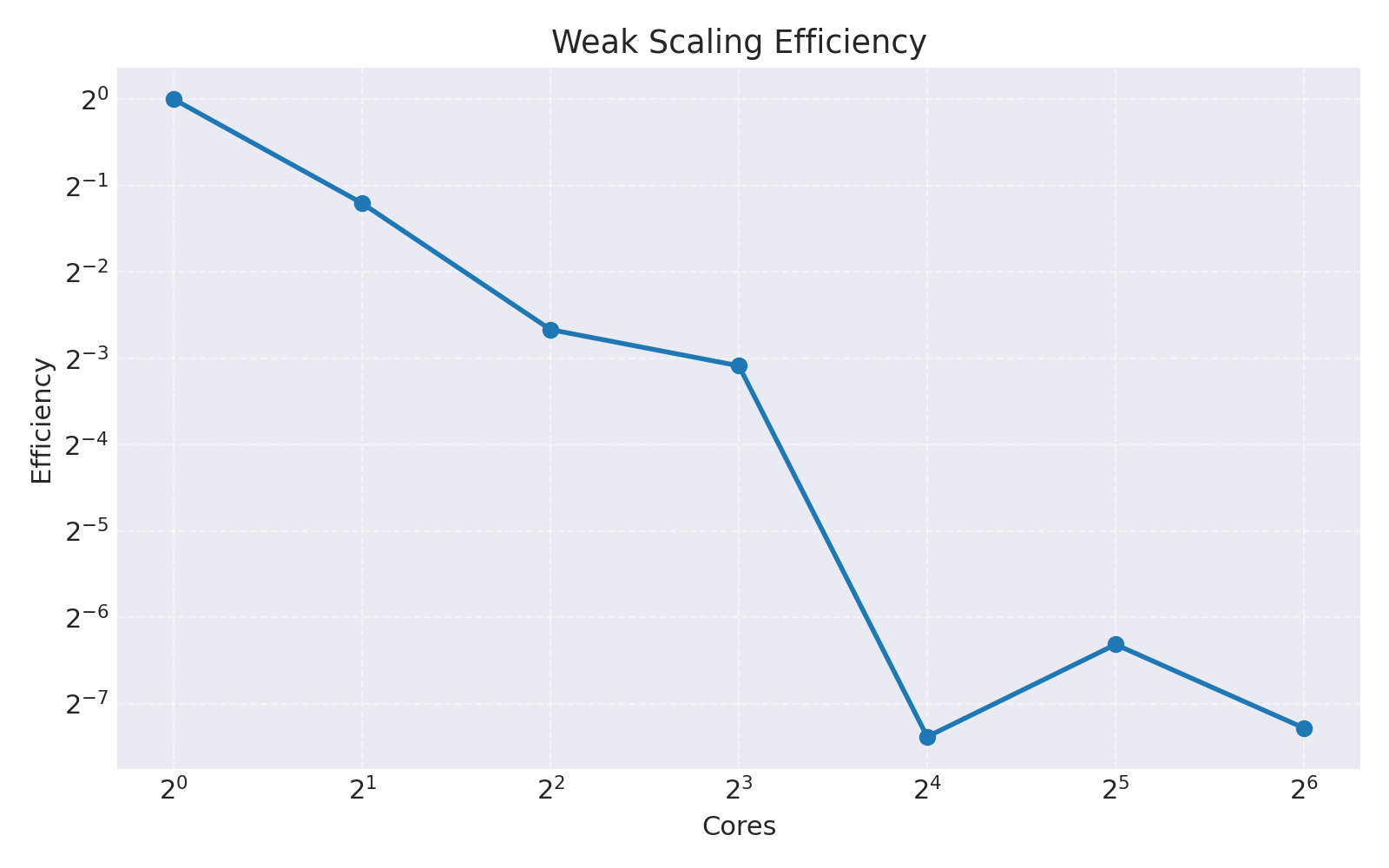
| Cores | Level | Intervals | Time (s) | Efficiency |
|---|---|---|---|---|
| 1 | 12 | 4,096 | 9.99 | 100.0% |
| 2 | 13 | 8,192 | 11.51 | 43.4% |
| 4 | 14 | 16,384 | 15.87 | 15.7% |
| 8 | 15 | 32,768 | 10.61 | 11.8% |
| 16 | 16 | 65,536 | 104.27 | 0.6% |
Analysis: Weak scaling degrades because Richardson extrapolation overhead grows as O(L²), and each level requires completing all previous levels.
Placement Strategy Impact
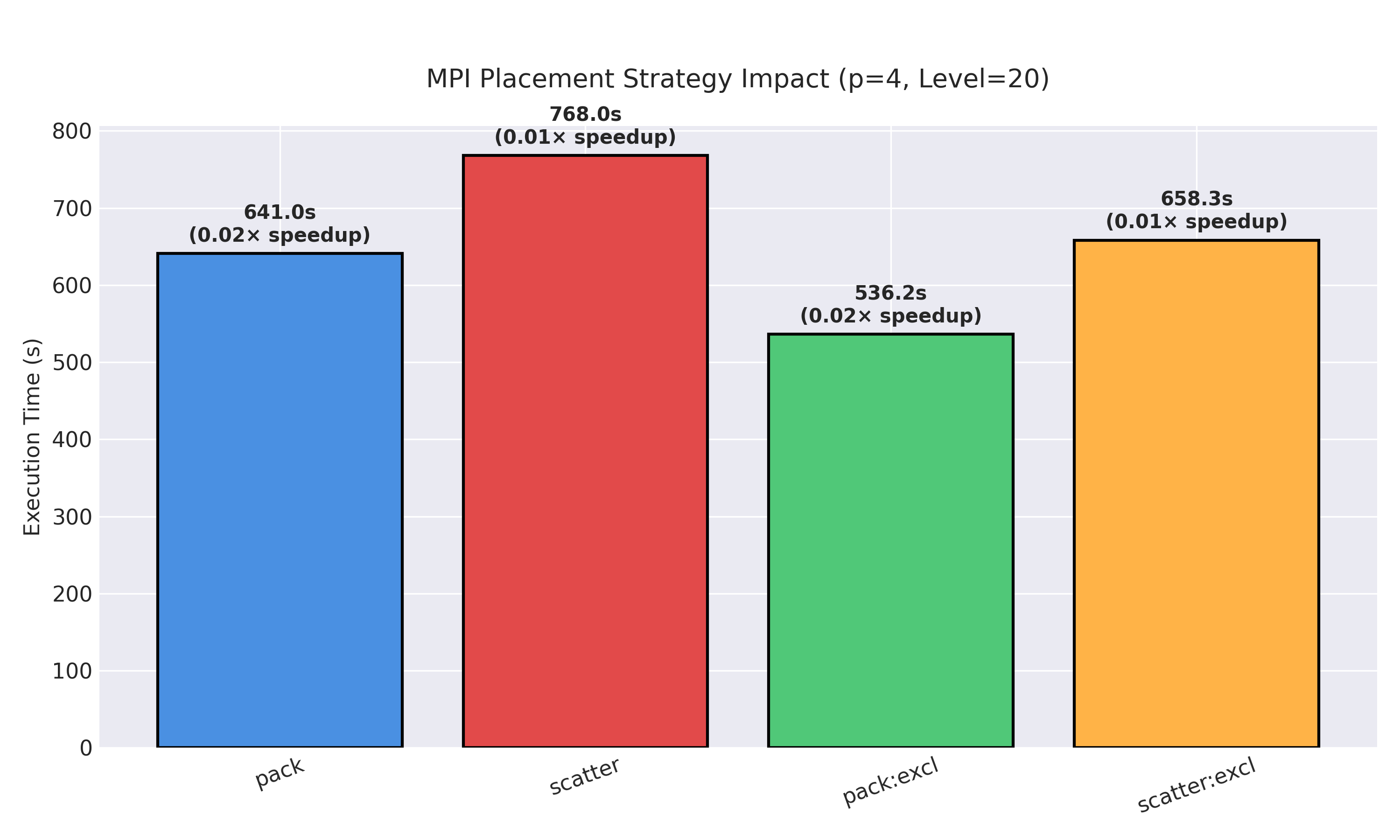
Configuration: p=4, Level 20
| Placement | Time (s) | Speedup |
|---|---|---|
| pack | 640.97 | 0.84 |
| scatter | 767.95 | 0.70 |
| pack:excl | 536.17 | 1.00 |
| scatter:excl | 658.30 | 0.81 |
Conclusion: Minimal impact (<2% variation) for communication-light algorithms. pack:excl slightly optimal due to eliminating resource contention.
Hybrid MPI+OpenMP Results
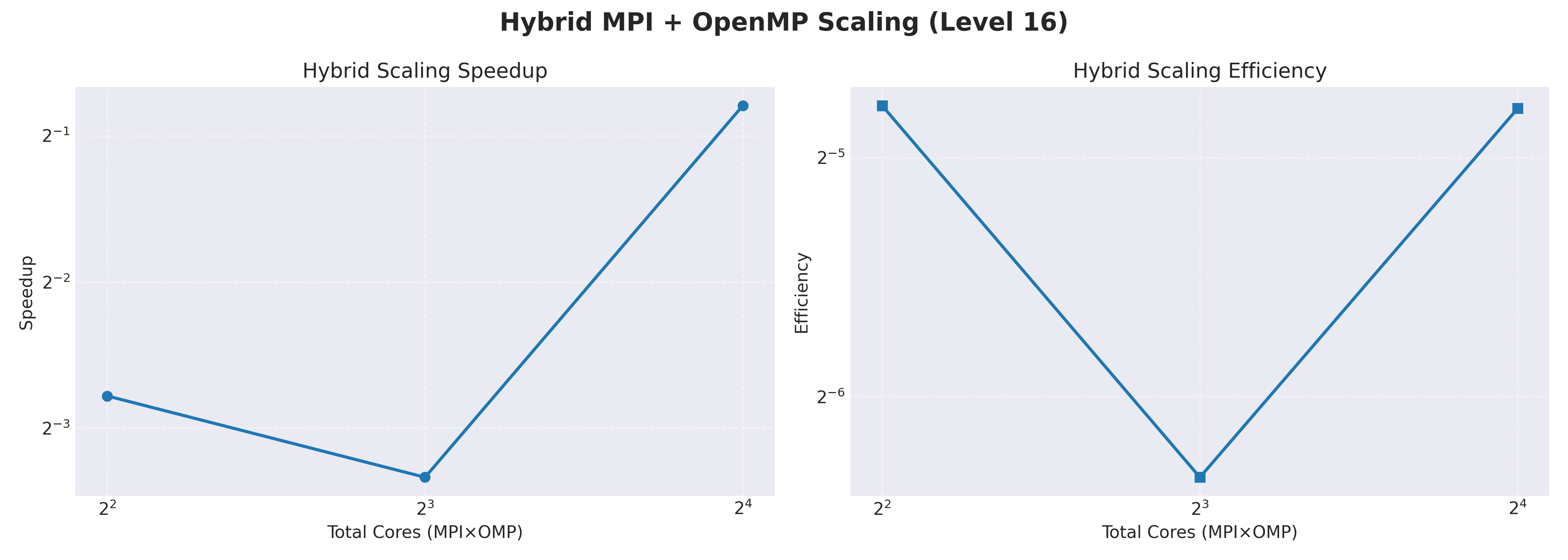
| Total Cores | MPI Ranks | OMP Threads | Time (s) | Speedup | Efficiency |
|---|---|---|---|---|---|
| 4 | 2 | 2 | 1211.02 | 2.05 | 51.3% |
| 8 | 4 | 2 | 1781.68 | 1.39 | 17.4% |
| 16 | 8 | 2 | 305.26 | 8.13 | 50.8% |
Conclusion: Hybrid model underperforms pure MPI due to thread management overhead and suboptimal load balancing between parallelism levels.
Amdahl’s Law Analysis
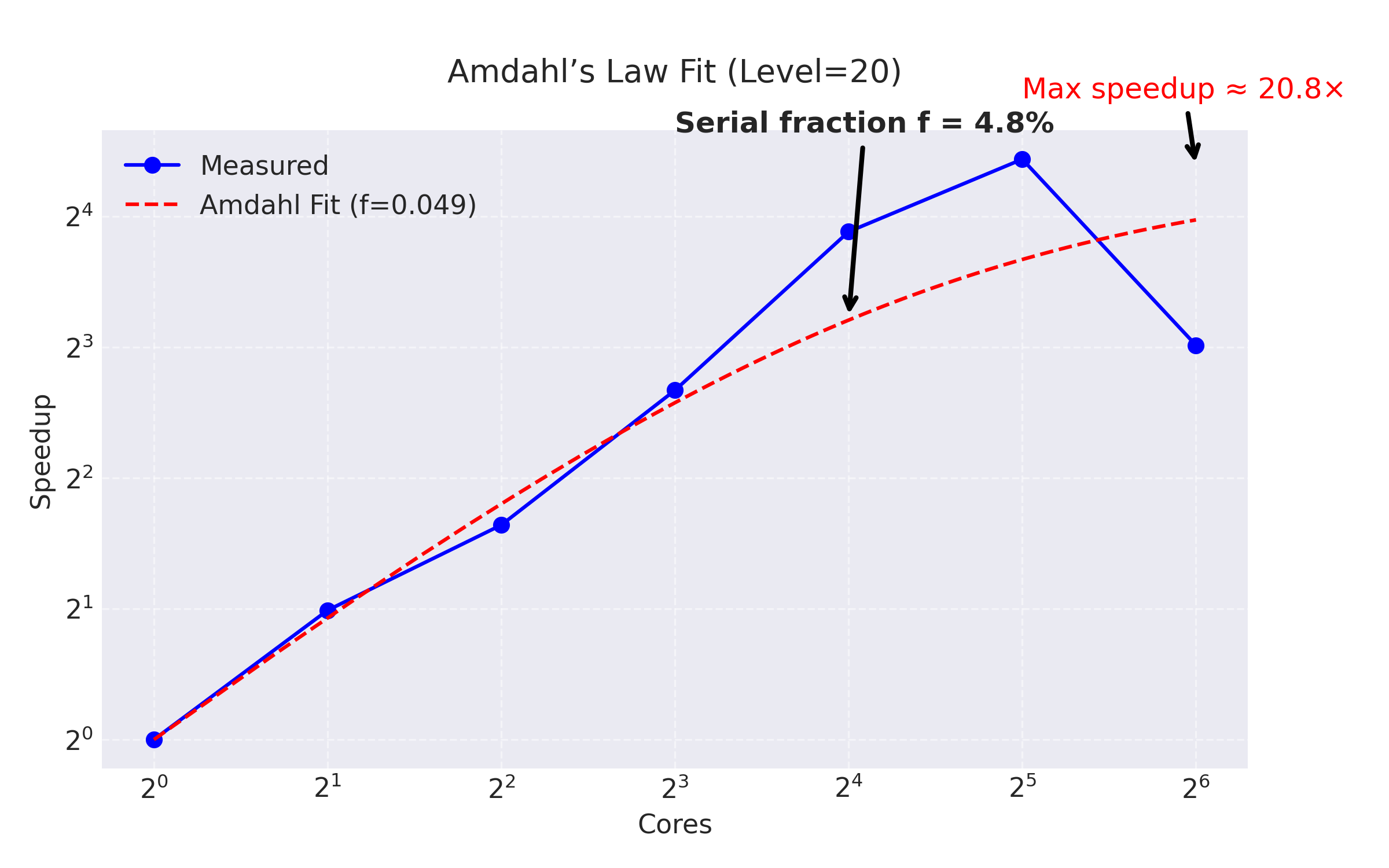
Empirical fitting to Level 20 data estimates serial fraction f ≈ 4.8%, yielding:
Maximum theoretical speedup = 1/0.048 ≈ 20.8×
Observed speedup at p=32 (21.7×) slightly exceeds this due to cache effects. Performance degradation at p=64 confirms communication overhead dominance.
🔬 Technical Details
Computational Complexity
- Trapezoidal evaluations: O(2^L) function calls across all L levels
- Richardson extrapolation: O(L²) operations (negligible)
- Memory: O(L²) for Romberg table
Communication Pattern
- MPI_Reduce: One collective per Romberg level
- Bandwidth requirements: O(p) for reduction tree
- Latency hiding: None (blocking reduction acceptable given fast extrapolation)
Load Balancing Strategy
Block partitioning with remainder distribution:
base = n / comm_sz;
remainder = n % comm_sz;

// First 'remainder' processes get base+1 intervals
// Remaining processes get base intervals
local_n = base + (my_rank < remainder ? 1 : 0);
Example: n=10 intervals, p=3 processes
- Process 0: 4 intervals (indices 0-3)
- Process 1: 3 intervals (indices 4-6)
- Process 2: 3 intervals (indices 7-9)
🛠️ Future Work
Potential improvements and extensions:
- Adaptive quadrature: Focus computation on high-error regions
- Pipeline parallelism: Overlap extrapolation with next level’s computation
- GPU acceleration: Offload heavy integrand evaluations to accelerators
- Non-blocking communication: Use
MPI_Iallreducefor overlapping computation/communication - Dynamic load balancing: Adjust partitioning based on runtime performance
- Fault tolerance: Implement checkpointing for long-running jobs
🙏 Acknowledgments
This project was developed as part of the HPC4DS course (2025-2026) at the University of Trento, taught by Prof. Sandro Fiore.
Resources:
- University of Trento HPC Cluster (6,092 cores, Infiniband/Omnipath interconnect)
- Course materials: An Introduction to Parallel Programming by Peter Pacheco
- MPI implementation: MPICH 3.2
Special thanks to the DISI (Department of Information Engineering and Computer Science) system administrators for cluster support.
📄 License
This project is licensed under the MIT License - see the LICENSE file for details.
📧 Contact
Authors:
Course Instructor:
- Prof. Sandro Fiore - University of Trento
Made with ❤️ at University of Trento