Industrial AI Challenge - Fedrigoni



Context
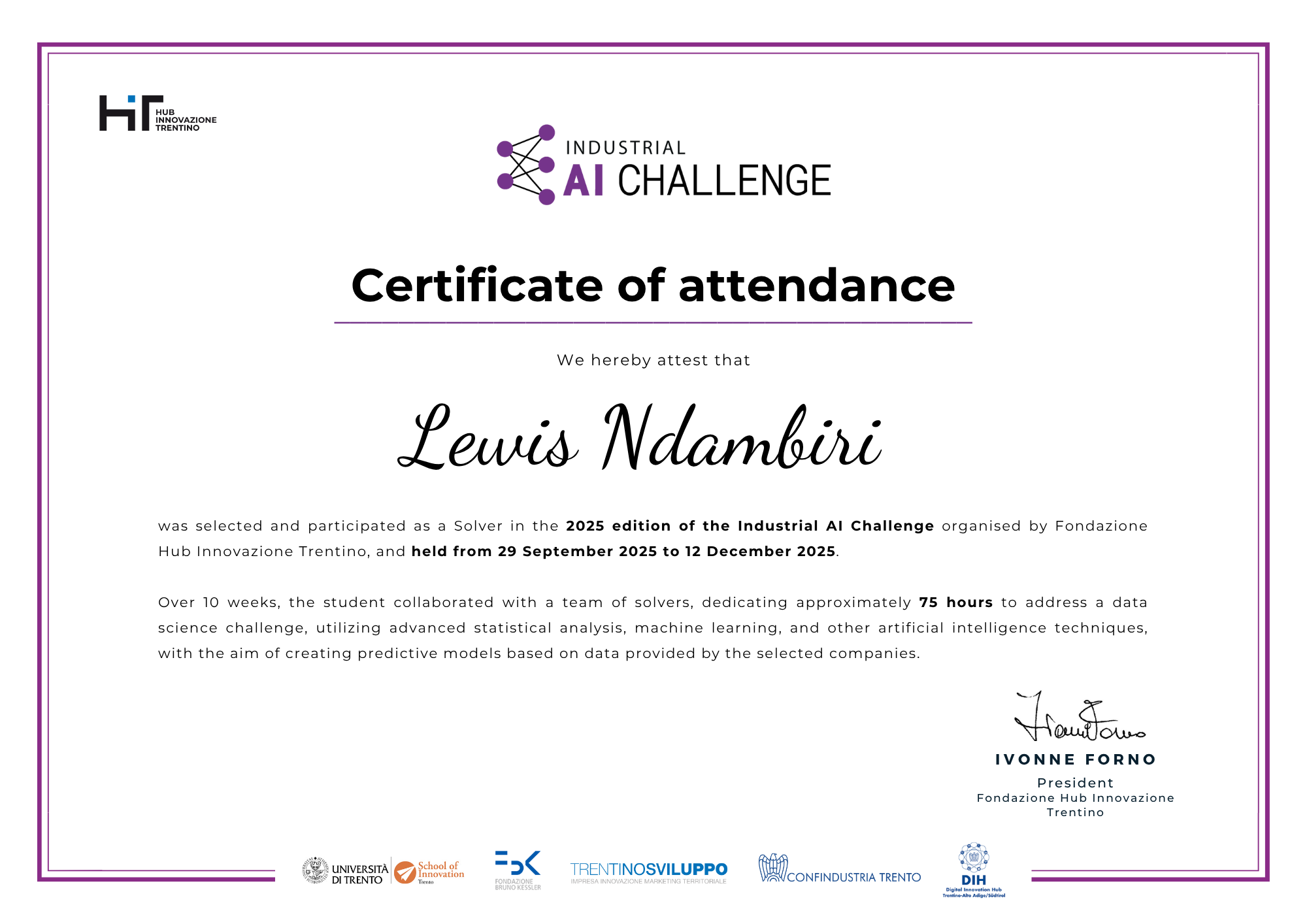
This project was developed as part of the Industrial AI Challenge, an initiative promoted by Hub Innovazione Trentino / Trentino Innovation in collaboration with partners including Università di Trento, Fondazione Bruno Kessler, Trentino Sviluppo, Confindustria Trento, Digital Innovation Hub, and UniTrento School of Innovation.
The public goal of the challenge is to connect university teams with real industrial datasets and help companies explore how artificial intelligence, statistical analysis, and machine learning can support production-process optimization. The 2025 edition involved student teams working on industrial AI problems over an intensive challenge period with company representatives, academic support, and technical mentors.
Within this setting, Team 3 worked on a manufacturing challenge proposed by Fedrigoni at the Arco plant, focusing on the slitting phase of self-adhesive material production.
Why This Problem Matters
In roll-based manufacturing, slitting is the conversion step where large semi-finished rolls are cut into smaller rolls according to customer requirements. It is a highly practical operation, but it is also sensitive to variability:
- Product mix changes from day to day.
- Setup and changeover requirements depend on the order profile.
- Machine capacity is finite and must be planned carefully.
- Delivery promises depend on whether production capacity is understood early enough.
- Material efficiency matters because leftover rolls, excess stock, and rework can create cost and sustainability pressure.
The business question was not simply “Can we build a model?” It was:
Can data help planners move from reactive production management to earlier, more reliable capacity decisions?
That framing made the project a strong example of industrial AI as decision support, not automation for its own sake.
Confidentiality Note
The public version of this case study intentionally omits proprietary datasets, internal feature names, production volumes, model parameters, detailed plant data, screenshots of internal tools, and company-specific operational values.
The focus here is on the transferable engineering approach: how to structure an industrial AI problem, connect operations knowledge with data science, evaluate models responsibly, and think about adoption in a real manufacturing environment.
Challenge Framing
The project sat at the intersection of three questions:
-
Capacity management
How can daily production capacity be estimated early enough to support planning? -
Product-mix complexity
How can a model account for the fact that different products create different production conditions? -
Operational decision support
How can predictions be presented in a way that helps planners act, while keeping human judgement in the loop?
This was important because industrial processes are rarely clean textbook datasets. The challenge required translating messy production reality into a modeling structure that still respected the plant context.
Process Understanding
Before modeling, we studied the production flow around the slitting operation. At a high level, the process can be described as:
flowchart LR
    A[Customer Demand & Forecasts] --> B[Production Planning]
    B --> C[Coating / Semi-Finished Rolls]
    C --> D[Slitting]
    D --> E[Quality Control]
    E --> F[Packaging & Shipping]
    D --> G[Capacity Signals]
    G --> B
The slitting area became the analytical focus because it is where product variety, setup requirements, machine constraints, and delivery pressure meet. From an industrial engineering perspective, this made it a capacity-planning problem as much as a machine-learning problem.
Methodology
We followed a CRISP-DM-inspired workflow, adapted to the rhythm of an industrial challenge:
flowchart TD
    A[Business Understanding] --> B[Data Understanding]
    B --> C[Data Preparation]
    C --> D[Feature Engineering]
    D --> E[Modeling]
    E --> F[Evaluation]
    F --> G[Operationalization Thinking]
    G --> B
1. Business Understanding
We translated the company challenge into a forecasting and decision-support problem. The target was to help production stakeholders reason about expected daily output and potential capacity pressure before it became visible operationally.
2. Data Understanding
The team explored multiple sources of production and planning information. Rather than treating the data as isolated tables, we mapped each source to the production logic behind it: demand signals, product categories, production history, machine-related information, and process context.
3. Data Preparation
The core data work involved cleaning, aligning, and aggregating heterogeneous information into a daily modeling view. This step was essential because industrial datasets often come from different systems, at different levels of granularity, and with different meanings.
4. Feature Engineering
The most important design idea was to represent not only “how much” was produced, but also “what kind” of production day it was. In manufacturing, two days with similar volumes can still be operationally very different if the product mix and setup complexity differ.
At a public level, the feature engineering covered:
- Calendar and time-based signals.
- Historical production behavior.
- Demand and planning context.
- Product-mix descriptors.
- Aggregated operational indicators.
5. Modeling
We compared classical machine-learning forecasting approaches with time-series-oriented methods. The goal was not to chase a single algorithm, but to evaluate which modeling family best handled daily variability, short-term trends, and product-mix effects.
The modeling work included:
- Tree-based regression baselines.
- Gradient boosting approaches.
- Time-series validation.
- Iterative feature refinement.
- Error analysis across different production conditions.
6. Evaluation
Evaluation was designed to reflect the real planning use case. Instead of relying only on a random train-test split, the model needed to be tested in a time-aware way, closer to how future production days would actually be forecast.
The public takeaway is that the final solution showed strong validation performance and provided a useful basis for short-horizon production-capacity support. Exact internal metrics and validation windows are omitted here for confidentiality.
What We Built
The project produced a predictive workflow for estimating daily slitting output from historical and contextual production signals.
At a high level, the system can be summarized as:
flowchart LR
    A[Production & Planning Data] --> B[Cleaning and Alignment]
    B --> C[Daily Feature Table]
    C --> D[Forecasting Models]
    D --> E[Evaluation]
    E --> F[Planner-Facing Output]
    F --> G[Capacity Decisions]
The intended use was not to replace planners. It was to give them an earlier signal: a structured forecast that could support workload balancing, delivery-date reliability, and proactive discussion around bottlenecks.
Industrial Engineering Lens
This project was especially valuable because it connected AI with core industrial engineering concepts.
Capacity Management
The slitting process has limited capacity, and small variations in product mix or setup requirements can affect daily throughput. A forecasting model can help create visibility before the constraint becomes painful.
Quality and Service Performance
In this context, quality is not only product conformity. It is also the ability to deliver consistently and reliably. Better planning stability can reduce last-minute pressure, rework risk, and service variability.
Lean and Waste Reduction
Predictive capacity support can contribute to leaner operations by reducing avoidable waiting, overproduction, excess inventory, and material remnants. The model therefore has a sustainability angle as well as an efficiency angle.
Human-Centered AI
The best industrial AI systems do not remove human expertise from the process. They help experts see earlier, compare options, and act with better information.
My Contribution
As part of Team 3, I contributed across the project lifecycle:
- Understanding the production-management problem and translating it into an AI use case.
- Supporting process analysis and industrial-engineering framing.
- Participating in data analysis, feature engineering, and model-evaluation discussions.
- Connecting model outputs to operational decisions such as capacity visibility, workload planning, and service reliability.
- Helping communicate the value of the solution from both technical and managerial perspectives.
What I Learned
This challenge reinforced several lessons that are central to industrial AI:
- A good model starts with a good operational question.
- Manufacturing data needs process context; columns alone are not enough.
- Forecasting is only useful if it supports a decision.
- Time-aware validation matters when the use case is future planning.
- Adoption depends on trust, interpretability, usability, and fit with existing workflows.
- AI in manufacturing should augment planners, operators, and engineers rather than bypass them.
Technical Stack
- Language: Python
- Data Analysis: Pandas, NumPy
- Visualization: Matplotlib, Seaborn
- Machine Learning: Scikit-learn, Random Forest, XGBoost
- Forecasting: Time-series validation, lag features, rolling statistics
- Experimentation: Iterative CRISP-DM workflow
- Interface Prototype: Streamlit
Future Work
If developed further, the concept could evolve toward:
- Integration with live ERP or MES data streams.
- Continuous model monitoring and drift detection.
- Planner feedback loops to improve model trust over time.
- Scenario simulation for product mix, workload, and capacity planning.
- Deeper integration with scheduling and material-availability constraints.
Public References
Conclusion
The Fedrigoni Industrial AI Challenge showed how data science can support real manufacturing decisions when it is grounded in operations knowledge. The strongest part of the work was not only the predictive model, but the translation of an industrial pain point into a structured decision-support system.
For me, the project sits exactly at the intersection of the skills I want to develop and apply: industrial engineering, AI, manufacturing systems, and human-centered operational improvement.